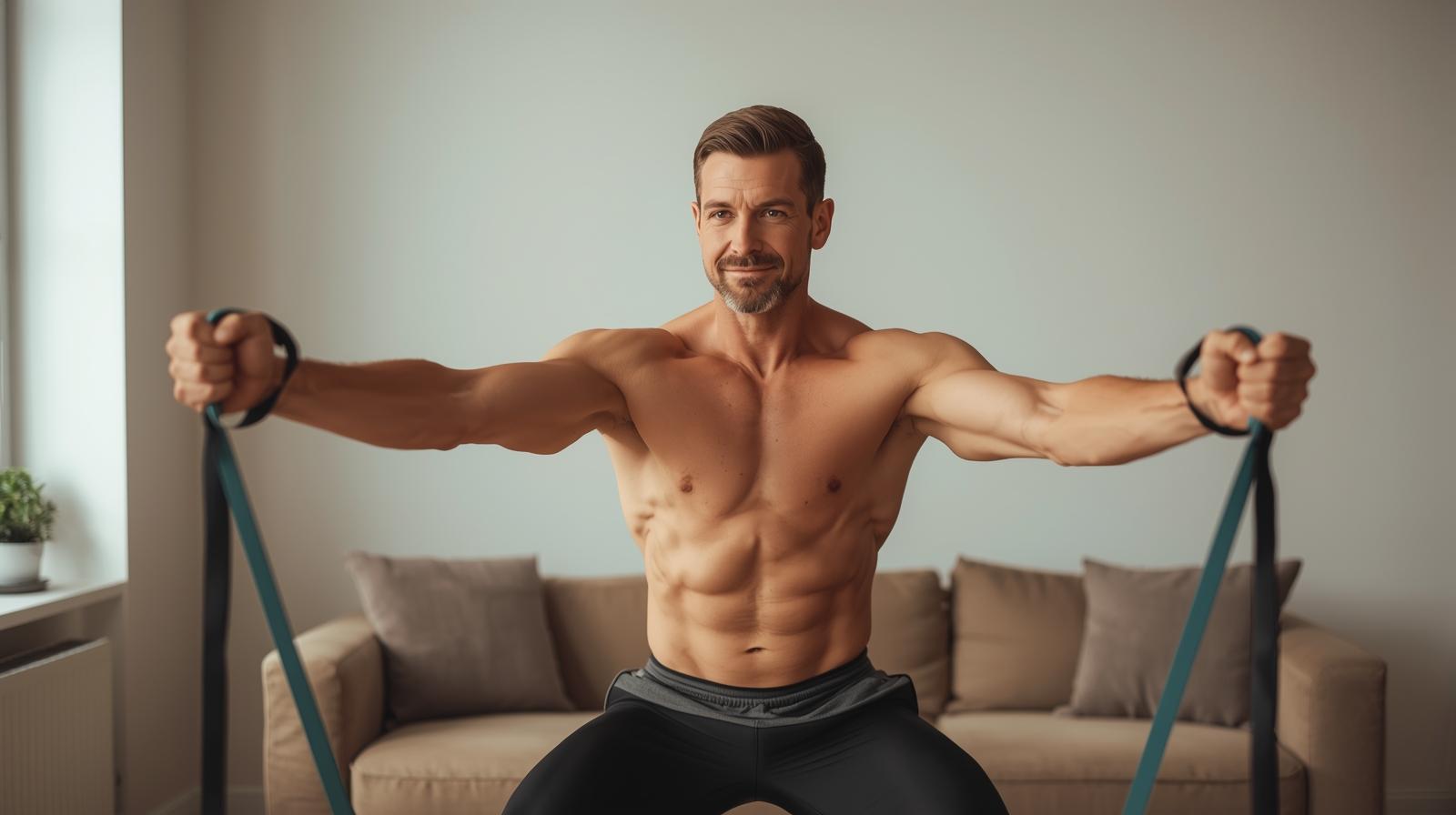
Resistance bands are one of the most efficient, accessible, and joint-friendly tools for full-body training. They provide continuous tension, accommodate natural movement paths, and allow strength development without requiring heavy equipment or large workout spaces. For busy individuals who want effective, science-backed full-body workouts at home or while traveling, band-only training can be structured to build muscle, increase strength, and support fat loss.
This guide explores mechanisms, biomechanics, program design, optimal exercise selection, and sample workouts-all grounded in exercise science and written for beginners to intermediate trainees.
What Makes Resistance Bands Effective?
Resistance bands create elastic tension, meaning resistance increases as the band stretches. This differs from free weights, which rely on gravity. The unique profile of elastic tension alters loading curves, muscular activation patterns, and joint stresses.
Key Scientific Advantages
- Accommodating resistance Bands increase resistance at longer muscle lengths or further into a movement-often where the muscles are strongest. Studies published in the European Journal of Sport Science show that accommodating resistance can enhance force production and motor unit recruitment.
- Joint-friendly loading Because bands reduce load where joints are mechanically disadvantaged, they decrease stress at the bottom of squats, rows, and presses. A 2019 study in the Journal of Strength and Conditioning Research noted reduced joint torque without reducing hypertrophic stimulus.
- High metabolic stress potential Bands create continuous tension, limiting rest between repetitions and amplifying metabolic stress-one of the primary drivers of muscle growth.
- Portable progressive overload Bands can be layered, doubled, or stepped on to increase tension, supporting long-term progression even for stronger trainees.
Why Full Body Workouts with Bands Work Especially Well for Busy People
Full-body training distributes the stimulus across major muscle groups in each session, allowing:
- Lower fatigue per muscle per workout
- Higher frequency with manageable recovery
- Better overall weekly training volume
- Fewer total workouts needed per week (2-3 is enough)
Resistance bands fit naturally into this structure because they require almost no setup, use minimal space, allow fast exercise transitions, and support compound movement patterns such as squats, hinges, pushes, and pulls.
Understanding the Biomechanics of Band Training
Elastic Resistance and the Strength Curve
Muscles produce different amounts of force at different joint angles. For example:
- The bottom of a squat is mechanically weak
- The top of a row is mechanically strong
- The mid-range of a press often produces peak torque
Bands match this curve more naturally than free weights. As the band length increases, so does tension, helping reduce injury risk, improve mechanical efficiency, maintain tension, and engage more muscle fibers.
Example: Band Row
- At arm extension (start), band tension is low → less joint torque
- At peak contraction (end), band tension is high → increased force where the back is strongest
Muscle Activation Research on Bands
Research shows that band-only training can produce similar activation and strength gains as free weights.
Key Findings
- Comparable strength gains A 2020 meta-analysis in Sports Medicine found elastic resistance training produced strength gains similar to traditional weightlifting.
- High EMG activation Banded pushes, squats, and rows can match free-weight muscle activation when tension is adequate.
- Greater stabilization demands Band instability recruits additional stabilizers around shoulders, hips, and spine.
Benefits of a Full Body Band Workout
1. Efficient Strength Development
Elastic tension activates large muscle groups effectively without heavy load.
2. Enhanced Joint Health
Bands reduce joint stress at deeper angles while still providing sufficient resistance.
3. Improved Movement Quality
Bands follow natural movement arcs, supporting better mechanics than fixed machines.
4. Portability
Bands are lightweight, compact, and travel-friendly.
5. High Customizability
More tension is added simply by increasing stretch or stacking bands.
Training Principles for Band-Only Full Body Workouts
1. Prioritize Multi-Joint Compound Movements
Focus on squats, hinges, pushes, pulls, carries, and anti-rotation patterns.
2. Use Progressive Overload
Increase challenge via:
- Stronger bands
- More stretch
- Higher reps
- Slower eccentrics
- Added sets
- Shorter rest periods
3. Train Close to Failure
Most sets should end with 1-3 reps remaining to maximize hypertrophy.
4. Balance Push vs Pull Work
Band pressing is easy to program. Pulling must be intentionally included.
5. Control the Eccentric Phase
Slow lowering increases tension and protects joints.
Best Full Body Band Exercises (Biomechanics Explained)
Lower Body
Banded Squat
Standing on the band with handles at shoulders provides increasing resistance as you stand. This matches natural strength curves and reduces bottom-position load.
Banded Hip Hinge / Deadlift
Creates highest tension near lockout where glutes and hamstrings are strongest.
Banded Glute Bridge / Hip Thrust
Bands deliver peak tension at full hip extension, ideal for glute hypertrophy.
Upper Body
Banded Row
High tension at peak contraction strengthens mid-back and scapular retractors.
Banded Chest Press
Anchored behind you, bands increase tension as arms extend, maximizing pectoral engagement.
Banded Overhead Press
Matches deltoid and triceps force production, with high tension at lockout.
Core
Pallof Press
Trains anti-rotation and deep core stability.
Banded Dead Bug
Adds resistance to limb movement for improved trunk control.
Comparison: Bands vs Dumbbells for Full Body Training
| Feature | Resistance Bands | Dumbbells |
|---|---|---|
| Load Curve | Variable | Constant |
| Joint Stress | Lower in weak positions | Higher in weak positions |
| Stability Demand | Higher | Moderate |
| Portability | Excellent | Poor |
| Space Required | Minimal | Moderate |
| Peak Tension | End-range | Mid-range |
| Best For | Home workouts | Max strength work |
Sample Full Body Band-Only Workout (Beginner to Intermediate)
Workout A: Strength & Hypertrophy
Warm-Up (5 minutes)
- Shoulder dislocates: 12
- Marching glute bridge: 15
- Squat + band pull-apart: 10
Main Training
- Banded Squat - 3 x 10-15 (60s rest)
- Banded Row - 3 x 12-15 (60s rest)
- Banded Chest Press - 3 x 10-15 (60s rest)
- Banded Romanian Deadlift - 3 x 12-15 (90s rest)
- Banded Overhead Press - 2 x 10-12 (60s rest)
- Pallof Press - 2 x 10-12/side (45s rest)
Workout B: Conditioning & Metabolic
Complete 3-4 rounds, resting 2 minutes between rounds:
- Banded Front Squat - 15-20
- Bent-Over Row - 15
- Banded Push-Ups - 8-12
- Banded Good Morning - 15
- Banded Power Walk/March - 30-45 sec
- Banded Reverse Crunch - 12-15
Programming Templates for Different Goals
Build Strength
- 2-3 weekly sessions
- 8-12 reps, 3-4 sets
- Thicker bands, longer rest
Build Muscle
- 2-4 weekly sessions
- 10-20 reps
- Slow eccentrics, continuous tension
Fat Loss & Conditioning
- 3 weekly full-body circuits
- Higher reps (15-25)
- Short rest intervals
Common Mistakes to Avoid
- Using bands that are too light
- Letting bands snap back
- Relying only on high reps
- Poor anchoring
- Skipping pulling exercises
Practical Tips for Maximizing Band Training
- Increase tension by stepping farther from the anchor
- Layer multiple bands for linear progression
- Track tension by marking band stretch length
- Slow down the eccentric
- Prioritize technique
Useful Resources
- YouTube: Athlean-X Resistance Band Basics
- Sports Medicine review on band training
- Movement tutorials by Strength Side
- NSCA Exercise Technique Manual
- Band exercise library at Bodybuilding.com
Frequently Asked Questions (FAQ)
Are resistance bands enough for a full body workout?
Yes. Research shows elastic resistance can match free-weight strength and hypertrophy outcomes when tension and progression are properly applied.
How often should you train full body with bands?
Most trainees do well with 2-4 weekly sessions.
Can bands build real strength?
Yes. Strength gains are comparable to dumbbells when bands are used with sufficient tension.
Do bands work legs effectively?
Yes. Squats, hinges, step-outs, and glute bridges all generate high tension with proper band selection.
Which band type is best?
Large loop-style bands offer maximum versatility.
Conclusion
A full body workout with bands only is an efficient, science-backed method for building muscle, developing strength, and supporting fat loss without heavy equipment or gym access. With proper exercise selection, progressive overload, and balanced programming, resistance bands can serve as a complete training system for long-term results.