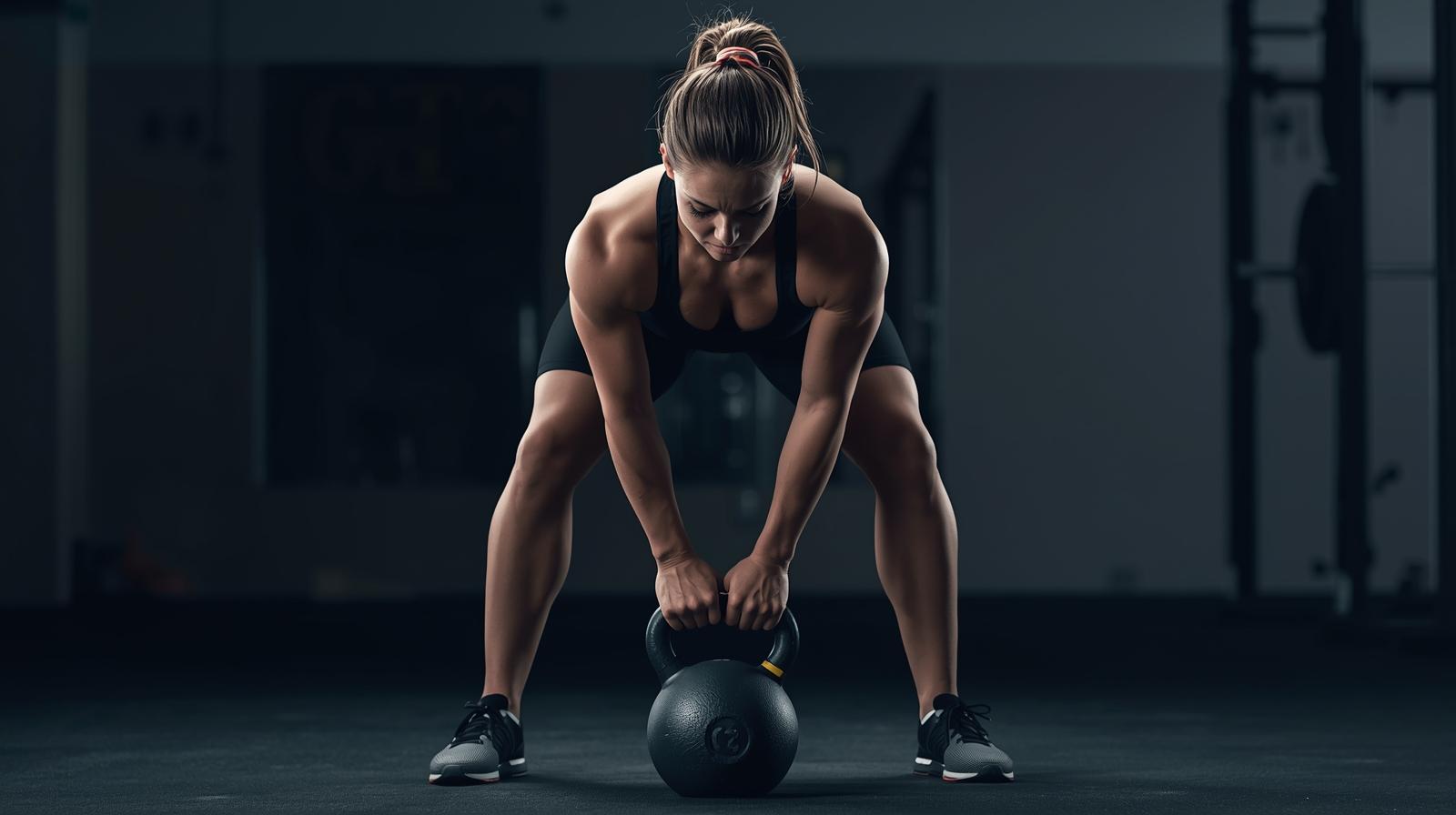
A full body kettlebell workout is one of the most time-efficient and physiologically effective training methods for busy adults seeking strength, leanness, and improved movement quality. Because of the kettlebell’s unique biomechanics-center of mass offset, continuous arc motion, and fluid transitions-it enables strength and conditioning adaptations that usually require multiple pieces of equipment or more training time.
This guide provides a deeply detailed, evidence-informed overview of full body kettlebell training, including mechanisms, programming principles, exercise selection, sample routines, technique cues, and common errors. It is designed for beginners to intermediate trainees who want a practical, comprehensive resource grounded in exercise science.
Table of Contents
- What Is a Full Body Kettlebell Workout?
- Why Kettlebells Are Effective for Full Body Training
- Physiological & Biomechanical Mechanisms
- Benefits for Busy Adults
- Essential Kettlebell Movement Patterns
- Full Body Kettlebell Exercise Library
- How Many Days Per Week Should You Train?
- How to Structure a Full Body Kettlebell Workout
- Two Complete Sample Workouts
- Common Mistakes and How to Fix Them
- Comparison: Full Body Kettlebell vs. Dumbbells vs. Bodyweight
- Frequently Asked Questions
- Conclusion
What Is a Full Body Kettlebell Workout?
A full body kettlebell workout is a training session that uses one or two kettlebells to target all major muscle groups in a single session. It incorporates a balanced selection of lower-body, upper-body, trunk, and ballistic movements to create a combination of:
- Strength
- Power
- Cardiovascular conditioning
- Core stability
- Mobility
Unlike isolated machine-based training, kettlebell workouts rely heavily on compound, multi-joint patterns that integrate the entire kinetic chain. This makes them ideal for:
- Maximizing training effectiveness with limited time
- Improving movement efficiency
- Developing total-body strength with minimal equipment
A full body kettlebell workout typically includes one or more movements from each of the following categories:
- Hip hinge (e.g., swing, deadlift)
- Squat (e.g., goblet squat)
- Push (e.g., overhead press, push-up)
- Pull (e.g., row)
- Loaded carry (e.g., suitcase carry)
- Core integration (e.g., kettlebell plank pull-through)
Why Kettlebells Are Effective for Full Body Training
The kettlebell’s offset center of mass produces unique mechanical loading compared to dumbbells or barbells. During dynamic movements like swings or cleans, the kettlebell’s arc requires continuous acceleration and deceleration, increasing demands on:
- Posterior-chain muscles
- Grip strength
- Trunk stiffness
- Stabilizing musculature
A 2018 study in the Journal of Strength and Conditioning Research found that kettlebell swings generate significant activation in the gluteus maximus, hamstrings, and spinal erectors, comparable to traditional barbell lifts for power output.
Additionally, kettlebell training allows fast transitions between exercises, reducing downtime and improving metabolic demand-a key advantage for busy trainees seeking efficiency.
Physiological & Biomechanical Mechanisms
1. High Mechanical Tension
Kettlebell exercises, especially single-arm variations, require significant stabilization. The offset load demands higher activation of muscles such as:
- Obliques
- Quadratus lumborum
- Scapular stabilizers
This improves functional strength for everyday tasks involving asymmetrical loads.
2. Enhanced Power Output
Ballistic kettlebell movements-swings, cleans, snatches-train rapid hip extension. This improves rate of force development, which research identifies as a major predictor of athletic performance and fall prevention.
3. Superior Cardiovascular Demand
Studies have shown kettlebell swings elevate heart rate to levels comparable to treadmill running intervals, making them an effective tool for conditioning within strength-focused workouts.
4. Improved Movement Integration
Kettlebell training reinforces coordination between the upper and lower body through:
- Timing
- Sequencing
- Breathing mechanics
This promotes better overall motor control.
5. Core Stability Through Anti-Rotation
Single-arm overhead presses, suitcase carries, and unilateral swings challenge the body to resist unwanted rotation. This enhances the deep core musculature that supports spine health.
Benefits for Busy Adults
1. Time Efficiency
A single kettlebell can deliver strength, power, and cardio in one session. Workouts often take 20-30 minutes while still hitting all major muscle groups.
2. Minimal Equipment Needed
One or two kettlebells replace:
- Barbells
- Dumbbells
- Machines
- Cardio equipment
This makes them ideal for home training.
3. Joint-Friendly Movements
The arc and natural path of kettlebell movements often feel smoother on joints than rigid barbell paths.
4. Scalable for Beginners and Intermediates
Load, tempo, and progression can be modified easily.
5. High Caloric Demand
Full-body, multi-joint movements increase metabolic cost-useful for individuals aiming to get lean.
Essential Kettlebell Movement Patterns
| Movement Pattern | Example Exercise | Primary Benefits |
|---|---|---|
| Hip Hinge | Kettlebell Swing | Power, posterior chain strength |
| Squat | Goblet Squat | Lower-body strength, mobility |
| Push | Strict Press | Shoulder strength, trunk stability |
| Pull | Bent-Over Row | Upper back development |
| Carry | Suitcase Carry | Core strength, grip |
| Anti-rotation | Half-Kneeling Press | Spine stability |
Full Body Kettlebell Exercise Library
Below are foundational exercises appropriate for most beginners and intermediates.
### 1. Kettlebell Swing (Hip Hinge)
Primary muscles: glutes, hamstrings, lower back Key benefits: power production, metabolic demand Technique cues:
- Hinge, don’t squat
- Keep the kettlebell close to the groin
- Drive through the hips
- Avoid excessive spinal extension
A 2019 study in the Journal of Human Kinetics found kettlebell swings produce significant posterior-chain activation similar to Olympic lifting derivatives.
### 2. Goblet Squat (Squat Pattern)
Primary muscles: quads, glutes, core Technique cues:
- Keep elbows close to the ribcage
- Maintain vertical torso
- Drive knees outward
- Keep feet flat
### 3. Kettlebell Strict Press (Push Pattern)
Primary muscles: deltoids, triceps, core Technique cues:
- Mini-glute squeeze for stability
- Press in a slight arc
- Avoid excessive lean-back
Unilateral pressing increases anti-lateral flexion demands on the core.
### 4. Kettlebell Row (Pull Pattern)
Primary muscles: lats, rhomboids, upper back Technique cues:
- Keep spine neutral
- Pull elbow toward the hip
- Avoid excessive torso rotation
### 5. Suitcase Carry (Loaded Carry)
Primary muscles: obliques, QL, forearms Technique cues:
- Walk tall
- Avoid leaning toward the kettlebell
- Slow, controlled steps
### 6. Turkish Get-Up (Integrated Movement)
Primary muscles: total body Key benefits: mobility, stability, coordination Note: Best added once foundational strength is established.
How Many Days Per Week Should You Train?
Most busy adults thrive on:
2-3 sessions per week
This frequency allows for:
- Full body stimulus
- Adequate recovery
- Progressive overload
- Sustainable long-term adherence
How to Structure a Full Body Kettlebell Workout
An effective structure includes:
1. Warm-Up (3-5 minutes)
- Hip hinge patterning
- Light swings or deadlifts
- Shoulder mobility
- Core activation
2. Power / Ballistic Work (optional)
- Kettlebell swings
- Kettlebell cleans
3. Strength Block (2-4 exercises)
- Squat
- Push
- Pull
- Hinge
4. Accessory Work
- Carries
- Anti-rotation exercises
- Mobility work
5. Conditioning Finisher (optional)
Examples:
- Swing intervals
- Squat-press complexes
6. Cool Down
- Light mobility
- Breathing drills
Two Complete Sample Workouts
These workouts are designed for 20-30 minutes, suitable for home or gym settings.
### Workout A: Strength + Power
Warm-Up
- 10 hip hinges
- 10 goblet squats
- 20-second front plank
Power Block
- Kettlebell Swings
- 10 reps x 5 sets
- Rest 45 seconds
Strength Block Perform as a circuit, 3-4 rounds:
- Goblet Squat - 8-10 reps
- Single-Arm Row - 8-10 reps per side
- Single-Arm Strict Press - 6-8 reps per side
Accessory
- Suitcase Carry - 30-40 meters per side
Cool Down
- Light mobility for hips and shoulders
### Workout B: Strength + Conditioning
Warm-Up
- Kettlebell deadlift - 10 reps
- Cat-camel - 10 reps
- Scapular wall slides - 10 reps
Strength Block Perform as supersets:
- Kettlebell Clean + Press
- 5 reps per side
- Goblet Squat
- 10 reps Repeat for 4 rounds.
Conditioning Finisher 15-minute EMOM (Every Minute on the Minute):
- Minute 1: 12 swings
- Minute 2: 6 rows per side
- Minute 3: Rest
Cool Down
- Box breathing
- Light stretching
Common Mistakes and How to Fix Them
1. Squatting the Swing
Issue: Excessive knee bend reduces hip power. Fix:
- Focus on hinging
- Keep shins vertical
2. Rounding the Back
Issue: Increased shear force on the spine. Fix:
- Neutral spine
- Engage lats
- Practice deadlift pattern
3. Pressing With a Loose Core
Fix:
- Squeeze glutes
- Brace trunk
- Use a moderate load you can control
4. Letting the Kettlebell Drift Away
Fix:
- Keep arc tight
- Pull kettlebell toward the body
5. Using Too Heavy a Weight Too Soon
Fix:
- Start with a controlled load
- Prioritize technique
Comparison: Full Body Kettlebell vs. Dumbbells vs. Bodyweight
| Feature | Kettlebells | Dumbbells | Bodyweight |
|---|---|---|---|
| Time Efficiency | High | Moderate | Moderate |
| Space Required | Very low | Low-moderate | Minimal |
| Power Development | Excellent | Moderate | Limited |
| Load Adjustability | Moderate | High | Low |
| Metabolic Conditioning | Excellent | Moderate | Moderate |
| Learning Curve | Moderate | Low | Low |
Kettlebells uniquely combine strength and conditioning, making them ideal for those with limited time.
Frequently Asked Questions
What weight kettlebell should beginners start with?
Most beginners do well with:
- Men: 12-16 kg
- Women: 8-12 kg These ranges allow learning technique without excessive load.
Are kettlebell swings good for fat loss?
Yes. Swings produce high cardiovascular and metabolic demand. A 2020 study in Strength and Conditioning Journal found kettlebell intervals can significantly increase caloric expenditure.
Can I build muscle with kettlebells only?
Yes-especially for beginners and intermediates. Mechanical tension, progressive loading, and adequate volume drive hypertrophy regardless of equipment type.
How long should a full body kettlebell workout be?
Most effective sessions last 20-35 minutes.
Should I use one kettlebell or two?
One kettlebell is sufficient for most beginners. Two kettlebells increase loading and complexity and work well for intermediates.
Do kettlebell swings replace deadlifts?
Swings train power and endurance, while deadlifts train maximal strength. They complement each other but do not replace one another.
Conclusion
A full body kettlebell workout is one of the most efficient and scientifically sound training methods for busy adults seeking strength, leanness, and functional fitness. With one or two kettlebells, it is possible to train all major muscle groups, develop power, improve cardiovascular conditioning, and enhance core stability in under 30 minutes.
By combining ballistic and strength movements, kettlebell training integrates biomechanics and physiology in a way few other tools can replicate. Whether you are a beginner building foundational strength or an intermediate trainee refining technique and improving conditioning, kettlebell training offers a sustainable, effective, and near-limitless progression path.